
There's a real difference between a freezer that's cold and one that's actually freezing food solid. Here's how to tell which one you have, and what that gap points to.
Quick Diagnosis
The freezer feels cold, but ice cream stays soft-set instead of scoopable-hard, or ice cubes never fully solidify.
Put an appliance thermometer in the freezer and leave it for a full 24 hours rather than judging by touch.
A reading anywhere in the teens or 20s°F, rather than the 0–5°F range a freezer should hold.
The unit is cooling, just not enough — that specific pattern points toward airflow, the door seal, or frost buildup before it points toward the compressor.
Check the door seal, reduce overpacking, look for frost buildup on the evaporator, and clean the condenser coils — all covered below.
If you smell anything burning, the compressor is too hot to hold your hand near, or the thermometer still reads in the teens after a full check, stop and call for service.
What Can Cause This Problem?
Temperature control set too warm or bumped
Freezer controls get nudged during cleaning or by kids reaching for something more often than people expect. A setting even a few notches warmer than the manufacturer's recommendation can be enough to keep the compartment cold to the touch without ever reaching true freezing performance.
Door not sealing fully
A gasket that's torn, dirty, or not making full contact lets warm, humid air into the freezer continuously. The compressor runs trying to keep up, and the compartment can stay in a partially-cold middle ground indefinitely rather than reaching its normal low temperature, especially if the door is opened often.
Overpacked freezer restricting internal airflow
Cold air needs to circulate from the evaporator throughout the compartment to freeze everything evenly. Shelves and bins packed solid, or food pressed directly against the vents, block that circulation — items near the vent freeze fine while everything else sits in the 15–25°F range and never fully hardens.
Frost buildup on the evaporator coil
If the automatic defrost cycle isn't running properly, frost accumulates on the evaporator coil until it restricts airflow much like a clogged air filter would. This typically develops gradually over one to a few weeks rather than appearing suddenly, and it reduces cooling capacity well before it blocks airflow completely.
Evaporator fan running weak or intermittently
A fan motor that's starting to fail may still turn, just not at full speed, or it may cut in and out. That's enough to move some cold air through the compartment — keeping things cool — without moving enough to bring the freezer down to its actual set temperature.
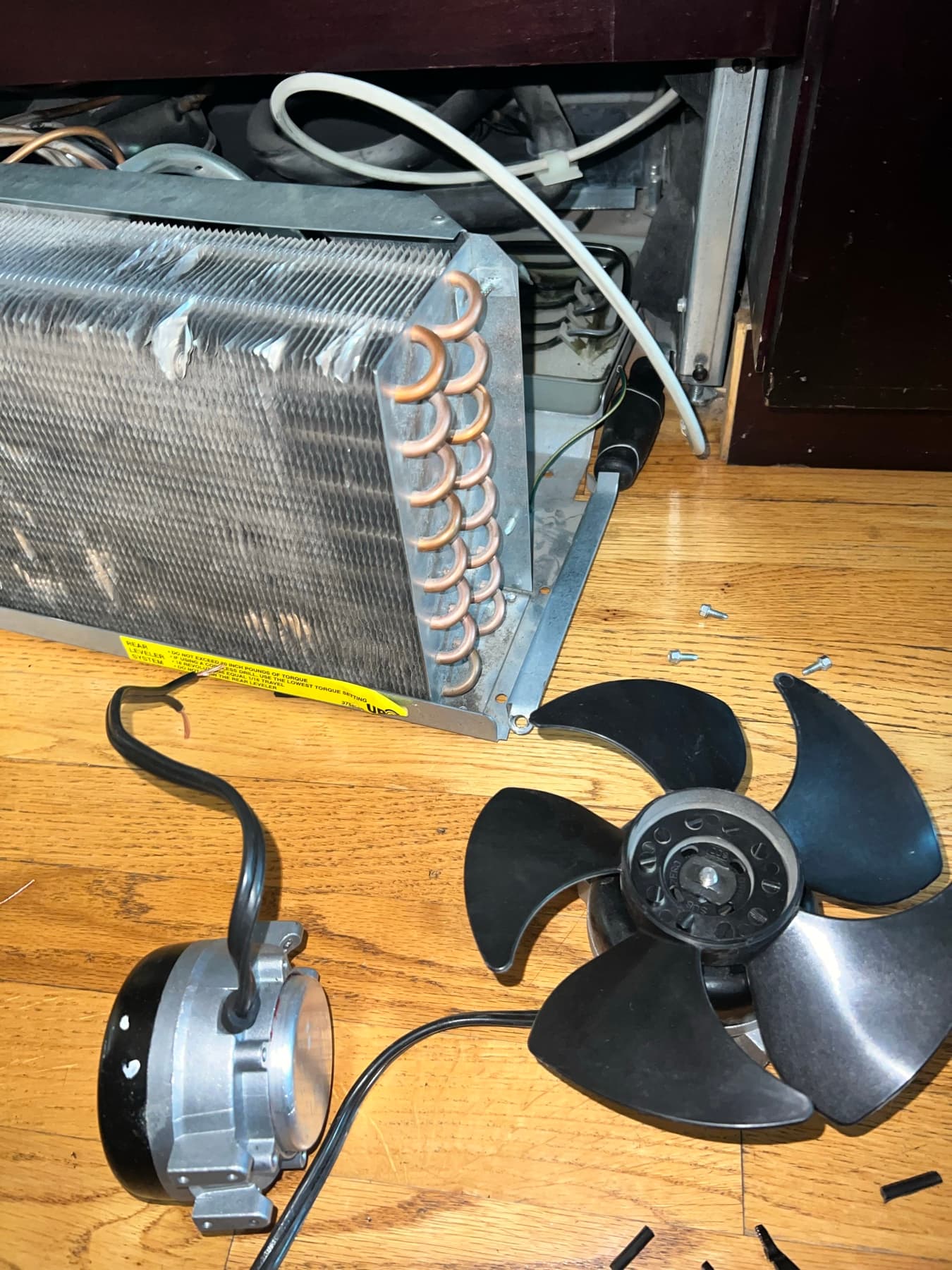
Dirty condenser coils or a weak condenser fan
The condenser releases the heat pulled out of the freezer; if it's coated in dust or the fan pushing air across it is underperforming, the whole system loses efficiency. The compressor keeps running, and the unit keeps cooling — just not enough to reach its lowest range, which is a different failure pattern than not cooling at all.
Compressor losing capacity or a partial sealed-system issue
A compressor that's mechanically wearing out, or a sealed system with a slow refrigerant leak, often produces exactly this kind of partial, underperforming cooling rather than a total failure — the unit still runs and still cools some, it just can't reach its designed low temperature. Confirming this requires gauges and amp draw testing, not something to diagnose by feel.
What to Check First
Actual temperature over 24 hours
SAFE FOR MOST HOMEOWNERS- How to check it
- Place an appliance thermometer in the middle of the freezer, away from the vent, and check it after a full 24 hours — not by touch and not after just 20 minutes.
- What the result may mean
- This is the single most important check — it's the difference between "feels cold" and "is actually freezing," and touch alone can't tell you that.
- Normal
- 0–5°F.
- Abnormal
- Consistently in the teens or 20s°F.
Temperature control setting
SAFE FOR MOST HOMEOWNERS- How to check it
- Check the dial or digital display against the manufacturer's recommended freezer setting.
- What the result may mean
- An incorrect setting alone can produce this exact symptom with nothing actually broken.
- Normal
- Set to the recommended range, not bumped warmer.
- Abnormal
- Set noticeably warmer than recommended.
Door seal contact
SAFE FOR MOST HOMEOWNERS- How to check it
- Close the freezer door on a strip of paper or a dollar bill at several points around the gasket and try to pull it out.
- What the result may mean
- Any gap lets warm air in continuously, which alone can keep the freezer from reaching full temperature.
- Normal
- Paper holds with light resistance all the way around.
- Abnormal
- Paper slides out easily in one or more spots.
Internal airflow and packing
SAFE FOR MOST HOMEOWNERS- How to check it
- Open the freezer and check whether food is pressed against the vents or shelves are packed edge-to-edge.
- What the result may mean
- Blocked airflow explains uneven or partial freezing — cold near the vent, weak everywhere else.
- Normal
- Vents clear, some space for air to circulate.
- Abnormal
- Vents blocked, compartment packed solid.
Frost pattern on the back wall or evaporator
SAFE FOR MOST HOMEOWNERS- How to check it
- Look at the back interior wall and any visible coil area.
- What the result may mean
- Points toward a defrost system problem restricting airflow, developing over days to weeks.
- Normal
- Little to no visible frost.
- Abnormal
- Heavy, thick frost or ice coating the back wall or coil.
Evaporator fan sound
SAFE FOR MOST HOMEOWNERS- How to check it
- Open the freezer door and listen closely near the back wall while the unit is running.
- What the result may mean
- A fan that's weak or intermittent moves some air but not enough to bring the compartment to full temperature.
- Normal
- A steady, moderate whirring sound.
- Abnormal
- No sound, an intermittent sound, or a grinding/clicking noise.
Condenser coil condition
SAFE FOR MOST HOMEOWNERS- How to check it
- Unplug the unit, then access the coils (bottom kick-plate or rear panel, model-dependent).
- What the result may mean
- Dirty coils reduce the system's overall cooling capacity, which shows up as underperformance rather than total failure.
- Normal
- Coils mostly clean, light dust at most.
- Abnormal
- Thick, matted dust and pet hair.
Compressor run pattern
ADVANCED — BETTER FOR A TECHNICIAN- How to check it
- With the unit accessible, listen and observe (don't touch) how long the compressor runs before cycling off over a couple of hours.
- What the result may mean
- A compressor running constantly without reaching temperature is consistent with reduced system capacity, which needs technician-level testing to confirm the cause.
- Normal
- Cycles on and off at intervals.
- Abnormal
- Runs continuously without ever cycling off, or short-cycles repeatedly.
Step-by-Step Checks
1. Get an accurate reading, not a felt impression
Place an appliance thermometer in the middle of the freezer, away from the vent, and leave it for a full 24 hours. Don't judge the freezer's performance by how cold it feels when you open the door — that tells you almost nothing about whether it's actually reaching 0–5°F.
2. Test with actual food, not assumptions
Check whether ice cream is scoopable-hard or soft-set, and whether ice cubes have fully solid centers or a soft, unfrozen core. Both are simple, objective signs that the compartment isn't reaching true freezing temperature even if it feels cold when you reach inside.
3. Check the door seal at multiple points
Close the door on a strip of paper at the top, middle, bottom, and both sides. If it pulls out freely anywhere, the gasket isn't sealing at that spot — clean it with warm soapy water and reseat it, or note it for replacement if it's visibly torn or deformed.
4. Reduce overpacking and clear the vents
Move food away from direct contact with the internal vents and remove a few items if shelves are packed edge-to-edge. Give it 24 hours after making changes before checking the thermometer again — freezers respond slowly, not within minutes.
5. Check for frost buildup and clean the condenser coils
Look at the back wall of the freezer for heavy frost, which points toward a defrost system issue. Separately, unplug the unit and vacuum the condenser coils (bottom or rear, depending on model) with a brush attachment, avoiding bending the fins.
Look, Listen, Observe
look
- Ice cream is scoopable or soft-set rather than rock hard — A reliable sign the freezer isn't reaching true 0–5°F range even if it feels cold to the touch.
- Ice cube centers stay soft or unfrozen — Same partial-cooling pattern as soft ice cream — objective evidence the compartment isn't fully freezing.
- Heavy frost coating the back wall or visible evaporator coil — Points toward a defrost system restricting airflow, developed gradually rather than overnight.
- Only a thin, normal layer of frost present — Rules out the defrost system as the likely cause — look elsewhere.
listen
- Evaporator fan whirring steadily near the back wall — Airflow is likely fine; the cause is probably somewhere else in the system.
- No fan sound, or an intermittent one — The fan isn't moving enough air to bring the compartment to full temperature.
- Compressor running continuously without ever cycling off — Consistent with the system working hard but not reaching full capacity.
observe
- Freezer performed fine in cooler months, worse in summer heat — Points toward condenser airflow and coil condition, since the system has to work harder against higher ambient heat.
Easy Things You Can Try
- Run the thermometer test — Leave an appliance thermometer in the freezer for 24 hours instead of judging by feel — this is the real diagnostic starting point.
- Clean and reseat the door gasket — Wipe it down with warm soapy water, dry it fully, and confirm it seals at every point with the paper test.
- Declutter to restore airflow — Move food away from vents and free up some space if shelves are packed solid.
- Vacuum the condenser coils — With the unit unplugged, clear dust and pet hair from the coils using a vacuum brush attachment.
Technician Tips
"Cold" and "freezing" aren't the same thing — a freezer stuck at 15–20°F will still feel cold to the touch but won't fully harden ice cream or ice cubes. That gap between feels-cold and is-actually-freezing is the single most useful diagnostic signal in this entire category of complaint.
If the evaporator fan is clearly running and there's no excess frost on the coil, the diagnostic focus shifts outward — toward the condenser and the compressor's overall capacity — rather than staying on the compartment itself.
A freezer that cools evenly across every shelf, just not enough, points more toward compressor capacity or condenser heat rejection than toward a duct or fan problem, since uneven cooling is the signature of an airflow issue and even-but-weak cooling isn't.
If the problem only became noticeable during a summer heat wave, checking condenser airflow and coil condition first is usually the fastest path to an answer, since the system has to reject more heat exactly when it's least able to if the coils are dirty.
Diagnostic Tricks
- SAFE FOR MOST HOMEOWNERS
Leave a full glass of water in the freezer overnight — if it hasn't frozen solid within 24 hours, that's objective proof of underperformance rather than a guess based on how the compartment feels.
- SAFE FOR MOST HOMEOWNERS
Check ice cube trays for cubes with soft or hollow centers rather than fully solid ones — an easy, no-equipment way to confirm the freezer isn't reaching full temperature.
- SAFE FOR MOST HOMEOWNERS
Time the compressor's on/off cycling over a couple of hours — a unit that never shuts off is working harder than a healthy system should, which is consistent with reduced overall capacity.
Error Codes
Many refrigerators show a code for this on the display. Codes vary significantly by brand and model, so check yours against the manufacturer's manual, or see our [appliance error code guide](/blog/appliance-error-codes) for commonly documented codes. Appliance error code guide.
Can I Fix This Myself?
Running the thermometer test, checking and cleaning the door seal, decluttering for airflow, and vacuuming the condenser coils are all safe for most homeowners and resolve a good share of these calls.
Diagnosing a weak or intermittent evaporator fan, or confirming that frost buildup points to a defrost system fault, usually means accessing interior panels — doable for a confident DIYer but easy to misjudge.
Anything pointing toward reduced compressor capacity or a sealed-system refrigerant issue needs gauges and amp draw testing to confirm. This isn't a DIY category regardless of experience level.
What Not to Do
- Don't judge freezer performance by touch alone — use a thermometer and actual food behavior (ice cream, ice cubes), since a compartment can feel cold and still not be freezing properly.
- Don't turn the temperature dial to its coldest setting hoping it helps — if the unit isn't reaching a normal setting, the coldest setting won't fix the underlying cause and just makes the real problem harder to diagnose later.
- Don't chip at frost buildup with a knife or other sharp tool — the evaporator coil sits close behind that frost and puncturing it means an expensive sealed-system repair instead of a simple defrost fix.
- Don't let a marginal freezer go unaddressed for more than a few days — food safety risk increases the longer a freezer sits in the 15–25°F range instead of its normal operating temperature.
When to Stop Troubleshooting
- You smell anything burning or electrical.
- The compressor housing is too hot to comfortably hold your hand near for more than a second or two.
- The thermometer confirms the freezer is stuck in the teens or 20s°F despite the door seal, airflow, frost, and coils all checking out normal.
- The freezer has been marginal for several days and you're concerned about food safety.
- Diagnosing further would require opening the sealed refrigerant system.
Don't Replace Parts Yet
A freezer that's cold but not truly freezing can stem from several different systems — the door seal, internal airflow, the defrost cycle, the evaporator fan, the condenser, or the compressor itself — and most of them produce a very similar "partially cooling" symptom from the outside. Replacing an evaporator fan motor or a compressor without first confirming which system is actually underperforming can mean paying for a part that wasn't the cause while the real issue, like a duct restricted by frost, continues unaddressed. Working through the checks in order, the way this guide does, is what actually narrows it down before any part gets replaced.
Frequently Asked Questions
This usually means the compressor and system are running but something is limiting how cold the compartment actually gets — the door seal, internal airflow, frost buildup on the evaporator, or reduced condenser or compressor capacity. It's a different pattern than a freezer that's not cooling at all.
Still not sure what's causing the problem?
Professional diagnosis can help identify the actual cause before replacing parts unnecessarily.