
Refrigerators aren't silent, and most of what you hear from one is completely normal. Here's how to tell everyday operating sounds apart from the ones that actually mean something.
Quick Diagnosis
You've noticed a sound from the refrigerator — humming, clicking, buzzing, rattling, or grinding — that's caught your attention.
Is the sound constant, or does it come and go with the compressor turning on and off, or with a specific cycle like defrost or ice making?
Note roughly where it's coming from: back/bottom near the compressor and condenser, top/interior near the evaporator fan, or near the door/dispenser.
Sound type and location together narrow things down far more than either one alone — a hum from the back is very different from a squeal from the freezer interior.
Check for obstructions around the fans, confirm the unit is level and has clearance from the wall, and listen for how the pattern changes over a full day.
If you hear grinding or knocking directly from the compressor, or notice a burning smell alongside any noise, stop and call for service.
What Can Cause This Problem?
Normal compressor hum and startup buzz
The compressor is an electric motor-driven pump, and a steady, moderate hum while it's running is completely normal operation. A brief buzz lasting a second or two right as it starts up or shuts off is also expected — it's the motor overcoming initial resistance, not a sign of a problem.
Something contacting a fan blade
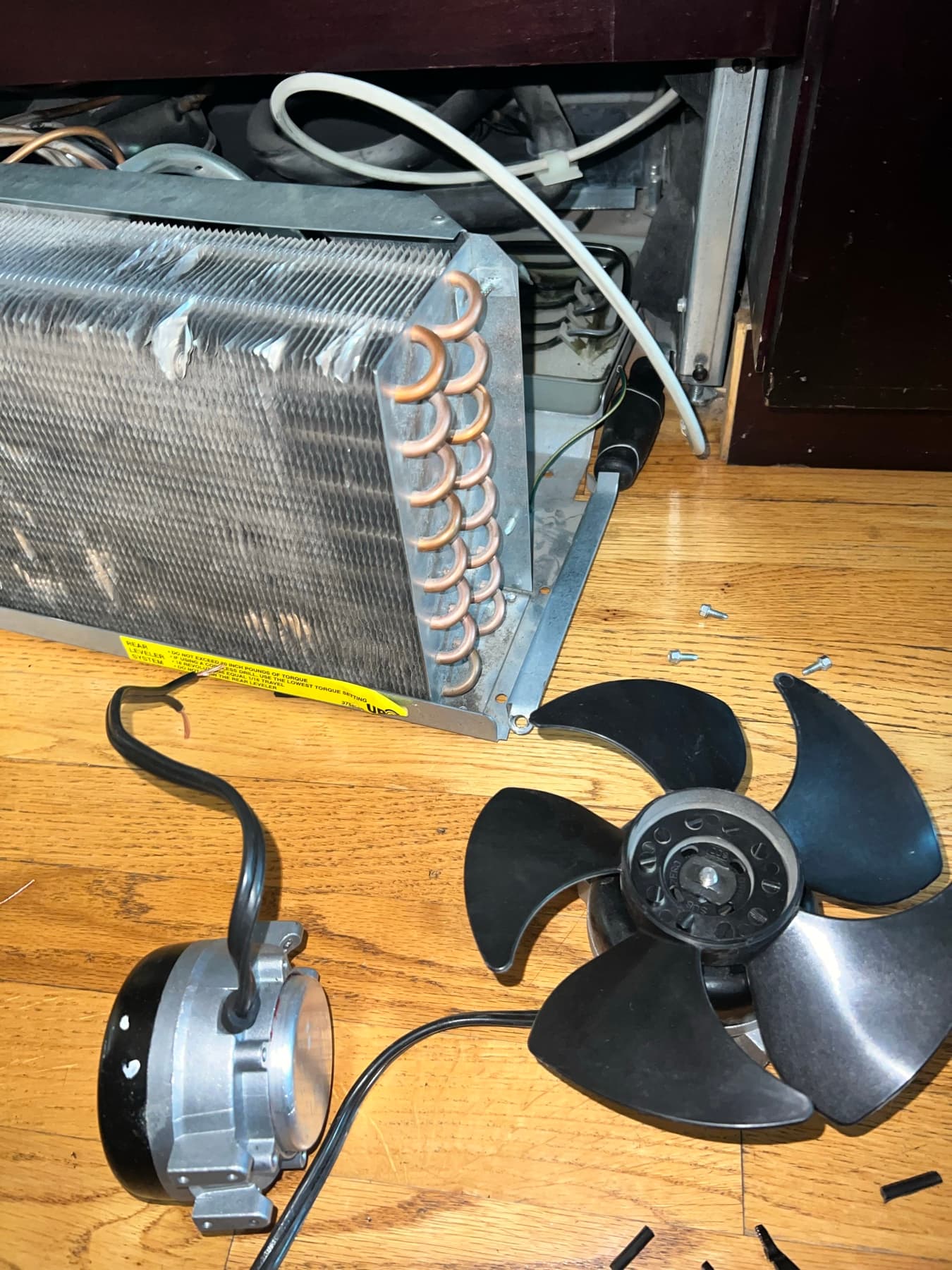
A rattle or intermittent clicking that changes with fan speed, or stops when you tap the cabinet, usually means a bottle, an ice chip, a dust clump, or a loose panel is physically contacting a spinning condenser or evaporator fan blade — not that the motor itself is failing.
Water valve or ice maker cycling
A buzz or clunk lasting a few seconds, often correlated with the ice maker filling or the water dispenser being used, is the water inlet valve energizing to let water through. It's a normal, expected sound tied to a specific, identifiable event.
Unit not level or resonance against nearby surfaces
A persistent rattle or buzz that changes noticeably when you touch the cabinet, move a nearby item, or nudge the unit is very often the refrigerator vibrating against the wall, cabinetry, or an item stored against its back panel — not a mechanical fault inside the unit at all.
Defrost heater or timer engaging
A click at roughly the same time each day, sometimes accompanied by a faint sizzling or ticking sound, is usually the defrost system engaging to melt frost off the evaporator coil on schedule. This is normal defrost operation, though a heater making unusual or louder-than-usual sounds is worth noting.
Evaporator fan motor bearings wearing out
A high-pitched whine or squeal that gradually gets louder over days or weeks, and is noticeably louder with the freezer door open, points toward a fan motor with bearings starting to wear — a different pattern than an intermittent rattle from debris hitting a blade.
Compressor start relay chattering or internal compressor wear
Repeated clicking every few minutes that never actually leads to the compressor starting and running suggests a failing start relay or capacitor trying and failing to get the motor going. A deep grinding or knocking sound coming directly from the compressor itself points toward internal mechanical wear — both require professional diagnosis rather than continued listening and waiting.
What to Check First
Sound timing and pattern
SAFE FOR MOST HOMEOWNERS- How to check it
- Listen over the course of an hour or two and note whether the sound is constant or comes and goes, and whether it correlates with the compressor cycling on/off.
- What the result may mean
- A sound tied to a specific, identifiable cycle is far more likely to be normal operation.
- Normal
- Sound correlates clearly with a known cycle — compressor running, defrost, or ice maker.
- Abnormal
- Sound is random, doesn't correlate with anything, or happens even when the unit should be idle.
Sound location
SAFE FOR MOST HOMEOWNERS- How to check it
- Listen at the back-bottom (compressor/condenser area), the interior back wall of the freezer (evaporator fan), and near the door/dispenser separately.
- What the result may mean
- Location combined with sound type narrows the cause significantly.
- Normal
- N/A — this is a localization check.
- Abnormal
- N/A
Condenser fan and coil area for obstruction
SAFE FOR MOST HOMEOWNERS- How to check it
- Unplug the unit and check the condenser fan and coils (bottom or rear, model-dependent) for anything contacting the blades.
- What the result may mean
- A common, easily fixed source of rattling that isn't a real mechanical failure.
- Normal
- Fan area is clear.
- Abnormal
- Debris, a fallen item, or heavy dust buildup near the blades.
Evaporator fan sound with the freezer door open
SAFE FOR MOST HOMEOWNERS- How to check it
- Open the freezer door and listen closely near the back interior wall.
- What the result may mean
- Points toward fan motor bearing wear rather than an obstruction.
- Normal
- A steady, moderate whirring sound.
- Abnormal
- A whine, squeal, or grinding sound, especially one that gets louder over time.
Unit level and rear clearance
SAFE FOR MOST HOMEOWNERS- How to check it
- Check that the unit sits level and has at least an inch or two of clearance from the wall.
- What the result may mean
- Contact with nearby surfaces can turn a minor internal vibration into an audible buzz or rattle.
- Normal
- Level, with clearance from the wall.
- Abnormal
- Touching the wall or cabinetry, or noticeably uneven.
Correlation with ice maker or dispenser use
SAFE FOR MOST HOMEOWNERS- How to check it
- Use the dispenser or trigger an ice maker cycle and listen for whether the noise happens at that exact moment.
- What the result may mean
- Confirms whether the water valve is the source or whether it's something else entirely.
- Normal
- A brief buzz or clunk tied directly to dispenser/ice maker use.
- Abnormal
- The noise happens independent of any dispenser or ice maker activity.
Repeated clicking without the compressor starting
ADVANCED — BETTER FOR A TECHNICIAN- How to check it
- Listen over several minutes for a click that repeats without ever being followed by the steady hum of the compressor running.
- What the result may mean
- Points toward a failing start relay or capacitor, which needs an amp draw or electrical test to confirm.
- Normal
- N/A — this pattern itself is the abnormal finding.
- Abnormal
- Rhythmic clicking every few minutes with no compressor startup following it.
Grinding or knocking directly from the compressor
DO NOT ATTEMPT- How to check it
- This requires distinguishing a true internal compressor sound from an external rattle, which often takes a trained ear and electrical testing to confirm.
- What the result may mean
- One of the few noise complaints that reliably points toward internal compressor wear rather than something incidental.
- Normal
- N/A
- Abnormal
- N/A
Step-by-Step Checks
1. Time the noise against the compressor cycle
Listen for the compressor's normal hum and note when it starts and stops over an hour or two. Check whether the noise you're concerned about happens only while the compressor is running, only when it starts or stops, or completely independent of it — that timing alone rules a lot in or out.
2. Locate the sound's general origin
Listen separately at the back-bottom of the unit (compressor and condenser), the interior back wall of the freezer with the door open (evaporator fan), and near the door or dispenser (ice maker and water valve). Most refrigerator noises trace to one of these three areas.
3. Check the condenser fan and coil area
Unplug the unit and access the condenser fan and coils, usually behind a bottom kick-plate or rear panel. Look and feel for anything — a dropped item, built-up dust, or pet hair — that could be contacting the spinning blades, and clear it out before plugging back in.
4. Listen at the evaporator fan specifically
Open the freezer door and listen right at the back interior wall. A steady whir is normal; a whine or squeal that gets louder with the door open, especially if it's been gradually increasing over days or weeks, points toward the fan motor's bearings wearing out.
5. Confirm level and clearance from the wall
Check that the unit sits level using a level placed on top, and that it has at least an inch or two of clearance from the wall and any cabinetry. Push gently on the top of the cabinet while the sound is happening — if it noticeably dampens, resonance against a nearby surface is likely a contributor.
Look, Listen, Observe
look
- Bottles, boxes, or ice buildup near the condenser or evaporator fan blades — A common, easily fixed source of rattling that isn't a real mechanical failure.
- The unit sitting unevenly or touching the wall or cabinetry — Vibration transferred into audible buzzing or rattling that has nothing to do with internal wear.
listen
- A steady, moderate hum while the unit is running — Normal compressor operation.
- A brief buzz lasting a second or two when starting up or shutting off — Normal compressor startup and shutdown.
- Rhythmic clicking every few minutes that never leads to the compressor actually running — Possible failing start relay or capacitor — worth having checked rather than waiting out.
- A high-pitched whine or squeal from the freezer, louder with the door open — Points toward evaporator fan motor bearing wear.
- Rattling that changes pitch with fan speed, or stops when you tap the cabinet — Usually an object contacting a fan blade or a loose panel, not a failing motor.
- Deep grinding or knocking directly from the compressor area — Points toward mechanical wear inside the compressor — a sound worth professional diagnosis, not continued monitoring.
observe
- Noise happens at roughly the same time every day — Likely tied to the automatic defrost cycle, which is normal unless paired with other symptoms.
Easy Things You Can Try
- Level the refrigerator — Adjust the front feet so the unit sits level and stops rocking or vibrating against the floor.
- Clear debris from the condenser fan area — With the unit unplugged, remove any dust, pet hair, or dropped items near the condenser fan and coils.
- Give the unit clearance from the wall — Leave at least an inch or two of space at the back so vibration doesn't transfer into nearby surfaces.
- Remove items resting against the back panel — Anything stored touching the rear of the fridge can pick up and amplify normal vibration into a rattle.
Technician Tips
Sound type alone rarely tells the whole story — timing and location together are what actually narrow things down. A sound tied only to defrost, only to ice maker cycles, or only to compressor startup points somewhere very different than one that's constant and unrelated to any cycle.
Rhythmic clicking that never resolves into the compressor actually starting is a classic start relay or capacitor symptom, and it's usually a fast, inexpensive fix once confirmed with an amp draw test — but it shouldn't be left running that way for long, since repeated failed start attempts stress the compressor windings.
A rattle that noticeably quiets down when you press a hand on top of the cabinet is almost always resonance or a loose panel, not a failing motor — a two-second test that saves a lot of unnecessary worry.
Grinding or knocking coming directly from the compressor itself is one of the few noise complaints that reliably means a compressor problem specifically, rather than something incidental like debris or a loose part.
Diagnostic Tricks
- SAFE FOR MOST HOMEOWNERS
With the unit unplugged, hold the end of a wooden spoon or cardboard tube near your ear and touch the other end to different spots on the cabinet as a low-tech stethoscope to help pinpoint exactly where a sound is loudest.
- SAFE FOR MOST HOMEOWNERS
Record the noise on your phone with a timestamp over a few hours, then compare it against when the compressor hum starts and stops — this makes the pattern much easier to describe accurately later.
- SAFE FOR MOST HOMEOWNERS
Press a hand flat on top of the cabinet while the noise is happening — if it dampens noticeably, resonance or a loose panel is a likely contributor rather than an internal component.
Error Codes
Many refrigerators show a code for other faults on the display, though unusual noises themselves rarely trigger one. Codes vary significantly by brand and model, so check yours against the manufacturer's manual, or see our [appliance error code guide](/blog/appliance-error-codes) for commonly documented codes. Appliance error code guide.
Can I Fix This Myself?
Leveling the unit, clearing debris from around the condenser fan, confirming wall clearance, and the hand-dampening test are all safe for most homeowners and resolve a real share of noise complaints.
Diagnosing evaporator fan bearing wear or pinpointing the exact origin of an intermittent rattle takes some patience and, sometimes, access to interior panels.
Grinding or knocking from the compressor, or rhythmic clicking that never leads to the compressor starting, both point toward electrical or internal mechanical issues that need meter testing to confirm.
What Not to Do
- Don't ignore grinding or knocking from the compressor hoping it resolves on its own — this pattern tends to get worse, not better, over time.
- Don't spray any kind of lubricant into a fan motor or electrical component — most modern fan motors are sealed, and lubricant sprayed into the wrong spot can attract more dust or damage electrical connections.
- Don't remove rear access panels while the unit is plugged in.
- Don't keep power-cycling a unit that's clicking repeatedly without the compressor starting — repeated failed start attempts put extra stress on the compressor's windings each time.
When to Stop Troubleshooting
- You hear grinding or knocking directly from the compressor area.
- There's a burning or electrical smell accompanying the noise.
- You notice sparking or visible damage to the power cord.
- The noise is accompanied by the refrigerator no longer cooling properly.
Don't Replace Parts Yet
Noise alone rarely confirms which specific part is involved, since several unrelated things — a loose panel, debris near a fan blade, a normal defrost cycle, and an actual failing motor — can all produce sounds that seem similar to an untrained ear. Replacing an evaporator fan motor or a compressor based on a noise complaint alone, without confirming the sound's timing and exact location first, risks paying for a part that wasn't making the sound at all. Working through where and when the noise happens, the way this guide walks through, is what actually identifies the source before any repair decision gets made.
Frequently Asked Questions
Yes, most of the time. A steady hum while running, a brief buzz at startup, occasional clicks tied to the ice maker or defrost cycle, and a soft whir from the evaporator fan are all normal parts of everyday operation.
Still not sure what's causing the problem?
Professional diagnosis can help identify the actual cause before replacing parts unnecessarily.